
If you’re exploring how modern fiber optic networks handle increasing data demands, understanding WDM and multiplexing is essential. These techniques allow multiple signals to share a single fiber efficiently, boosting capacity without laying new cables. By assigning different wavelengths to each data stream, you can maximize bandwidth and reduce costs. But how exactly does this process work, and what makes WDM so indispensable for today’s high-speed communications?
Key Takeaways
- Multiplexing combines multiple data streams into a single signal for efficient transmission.
- Wavelength Division Multiplexing (WDM) uses different light wavelengths to carry separate data channels over one fiber.
- WDM maximizes fiber capacity by allowing multiple wavelengths to coexist without interference.
- It enables scalable network expansion by adding new wavelengths without laying extra cables.
- WDM is widely used in high-speed optical networks to improve bandwidth and network reliability.

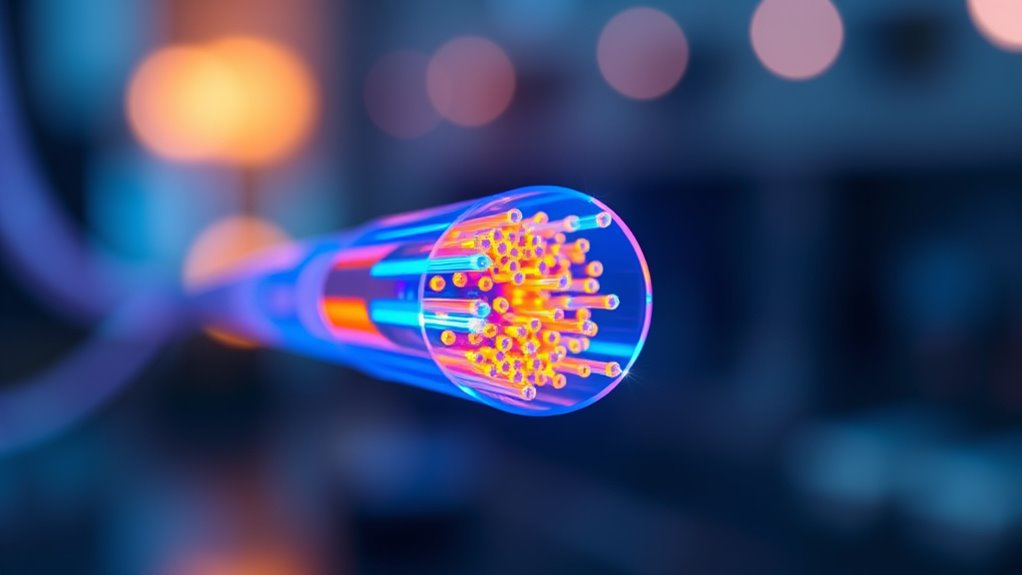
Have you ever wondered how multiple signals travel simultaneously over a single optical fiber? It’s a fascinating process that hinges on the technology of fiber optics and clever bandwidth management. Fiber optics use thin strands of glass or plastic to transmit data as light pulses, allowing for high-speed communication over long distances. But what makes this possible is the ability to manage the spectrum of light signals efficiently, which is where multiplexing comes into play.
Multiplexing enables you to send multiple data streams through a single fiber by combining them into one composite signal. This process markedly boosts the fiber’s capacity without the need for laying additional cables. Among various multiplexing techniques, Wavelength Division Multiplexing (WDM) is the most prominent in modern optical networks. WDM works by assigning different wavelengths or colors of light to different data channels. Each wavelength acts like a separate lane on a highway, allowing multiple signals to travel side by side without interference. This setup maximizes the bandwidth potential of fiber optics, making it possible to handle vast amounts of data efficiently.
When you think about bandwidth management in fiber optics, WDM is a game-changer. It allows you to allocate specific wavelengths for various services or users, optimizing the flow of data according to priority or demand. For example, high-priority traffic like financial transactions can be assigned dedicated wavelengths, while less critical data shares other channels. This flexibility ensures that the network remains efficient and scalable as your data needs grow. WDM also makes upgrading your network easier because you can add new channels simply by introducing new wavelengths, rather than installing new fibers.
The beauty of this system is that it preserves the integrity of each signal while maximizing the use of the available spectrum. By doing so, WDM not only increases capacity but also enhances network reliability and performance. As data traffic continues to surge with the rise of streaming, cloud computing, and IoT devices, proper bandwidth management becomes even more crucial. WDM offers a solution that adapts to these demands, providing a scalable, cost-effective way to expand network infrastructure. Additionally, multiplexing techniques like WDM are essential for making the most of existing fiber infrastructure, reducing costs and complexity for network operators.
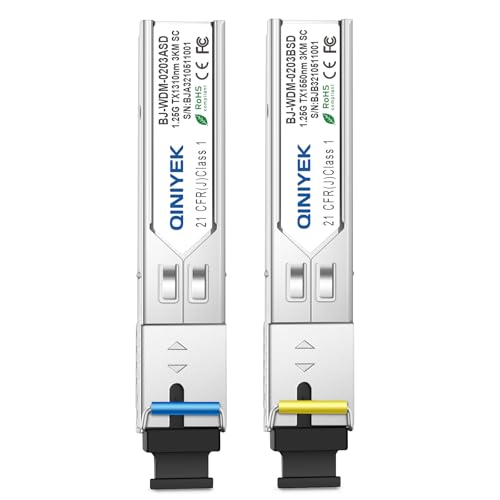
1 Pair simplex SC Module 3KM, 1.25G Single-Mode Fiber Connector, SFP-WDM-SM 1000BASE BiDi 1310nm/1550nm SFP Transceiver Module
Optical BIDI SFP module: 1.25G Data Rate; Reach: 3 km
As an affiliate, we earn on qualifying purchases.
As an affiliate, we earn on qualifying purchases.
Frequently Asked Questions
How Does WDM Compare to TDM in Performance?
WDM generally outperforms TDM in spectral efficiency and bandwidth utilization. You get higher data rates since WDM uses multiple wavelengths simultaneously, maximizing the fiber’s bandwidth. TDM shares the bandwidth over time, which can limit performance when traffic increases. So, WDM is better suited for high-capacity networks, providing more efficient use of available spectrum and enabling faster, more reliable data transmission.
What Are the Main Challenges in Implementing WDM Systems?
You face several challenges with WDM systems, especially in fiber optics. Signal degradation, caused by attenuation and dispersion, can reduce data quality, requiring careful management. Implementing precise wavelength control, managing cross-talk, and guaranteeing system scalability add complexity. Additionally, maintaining polarization stability and dealing with equipment costs make deployment tricky. You need to balance technical precision with cost-effectiveness to ensure reliable, high-capacity fiber optic communication networks.
Can WDM Be Used in Wireless Communication?
Yes, you can use WDM in wireless communication, but it’s more complex than in fiber optics. WDM works by combining multiple signals at different wavelengths, which can be transmitted over a single radio frequency channel. However, you need to oversee signal interference carefully, as overlapping wavelengths may cause issues. Proper filtering and frequency planning are essential to prevent interference and ensure clear, efficient wireless WDM transmission.
What Are the Future Trends in Multiplexing Technology?
They say, “The future belongs to those who innovate.” You’ll see multiplexing technology evolve with adaptive optics, enhancing signal clarity and capacity. Quantum multiplexing promises unprecedented security and efficiency by utilizing quantum states. These trends aim to meet growing data demands, enabling faster, more reliable communication systems. Embracing these advances, you’ll experience smarter networks that adapt dynamically, pushing the boundaries of what’s possible in telecommunications.
How Does WDM Impact Network Scalability and Flexibility?
WDM substantially boosts your network’s scalability and flexibility by enabling fiber expansion without needing new cables. It allows you to increase bandwidth management efficiently, as multiple signals travel simultaneously over different wavelengths. This means you can expand your capacity easily as demand grows, optimizing existing infrastructure. WDM’s ability to add or upgrade channels on the fly makes your network adaptable, ensuring it meets future needs with minimal disruption.

2 x POTS RJ11 Telephone and Gigabit Ethernet Over Fiber Converter – Multiplexer – Extender Set of FXS FXO Units – Universal Single and Multimode – 1 km MM (0.6 mi) 20km SM (11.4 mi) – Voice Over Fiber
Protect Your Home: Bulletproof Phone to Fiber fiber cable extender for long, prone to lightning, lengthy outdoor copper…
As an affiliate, we earn on qualifying purchases.
As an affiliate, we earn on qualifying purchases.
Conclusion
In essence, WDM and multiplexing are like a busy highway, allowing multiple cars—your data streams—to travel side by side without collisions. They maximize your fiber optic network’s capacity, making it more efficient and cost-effective. By combining different wavelengths, you can send more information simultaneously, just like lanes on a road accommodate more vehicles. Embracing these technologies helps you build faster, smarter communication systems that keep up with today’s high-demand digital world.

Togo TELECOM awards contract to Xtera for high-capacity optical network.(CONTRACTS): An article from: Fiber Optics Weekly Update
As an affiliate, we earn on qualifying purchases.
As an affiliate, we earn on qualifying purchases.

NOYAFA NF-8508 Network Cable Tester with Optical Power Meter, CAT5 CAT6 Cable Toner Ethernet Cable Tester, RJ45 Network Tester, VFL PoE QC Test Wire Tracer Port Flashing 200M Length Test
Multifunctional NOYAFA NF-8508 Network Cable Tester: There are nine features to meet your needs. Continuity Testing, Cable Scan,…
As an affiliate, we earn on qualifying purchases.
As an affiliate, we earn on qualifying purchases.